Oki Universe
Oki and the Many Islands
The Illustrated Children’s Guide to OpenKubes
A story about clear promises, honest evidence, and people who take responsibility.
Oki Universe
The Illustrated Children’s Guide to OpenKubes
A story about clear promises, honest evidence, and people who take responsibility.
The family stays together because they can rely on one another.
The islands are connected by promises they understand together—not by one particular tool.
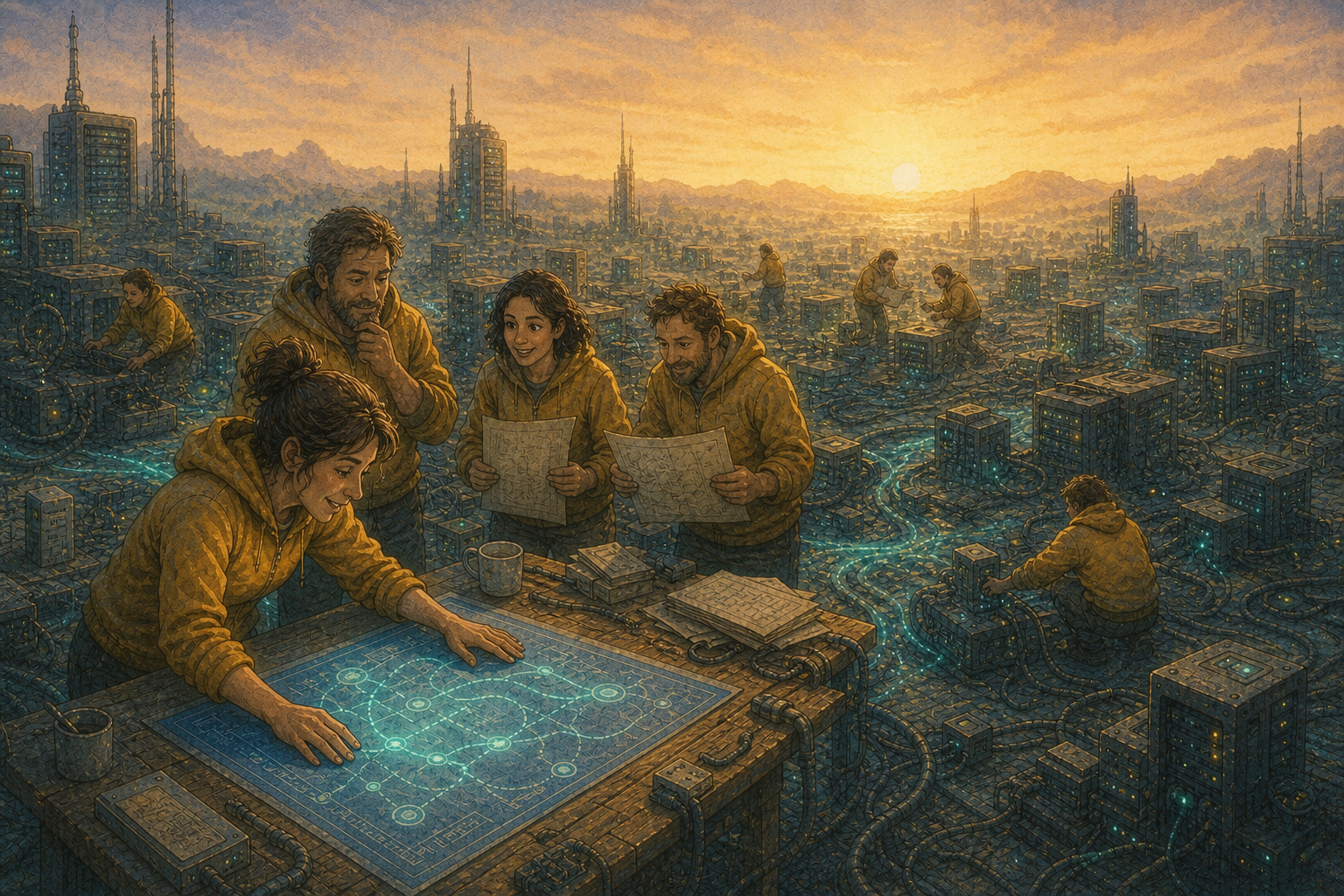
Before there was Oki, there was only a wide land of computers, cables, and blinking lights.
Many good machines stood across the land. But each one worked a little differently. Some knew exactly what to do. Others waited for instructions. And whenever someone wanted to build a new island, they had to figure everything out all over again.
The people carried plans back and forth.
“There must be a more reliable way,” said one of the builders.
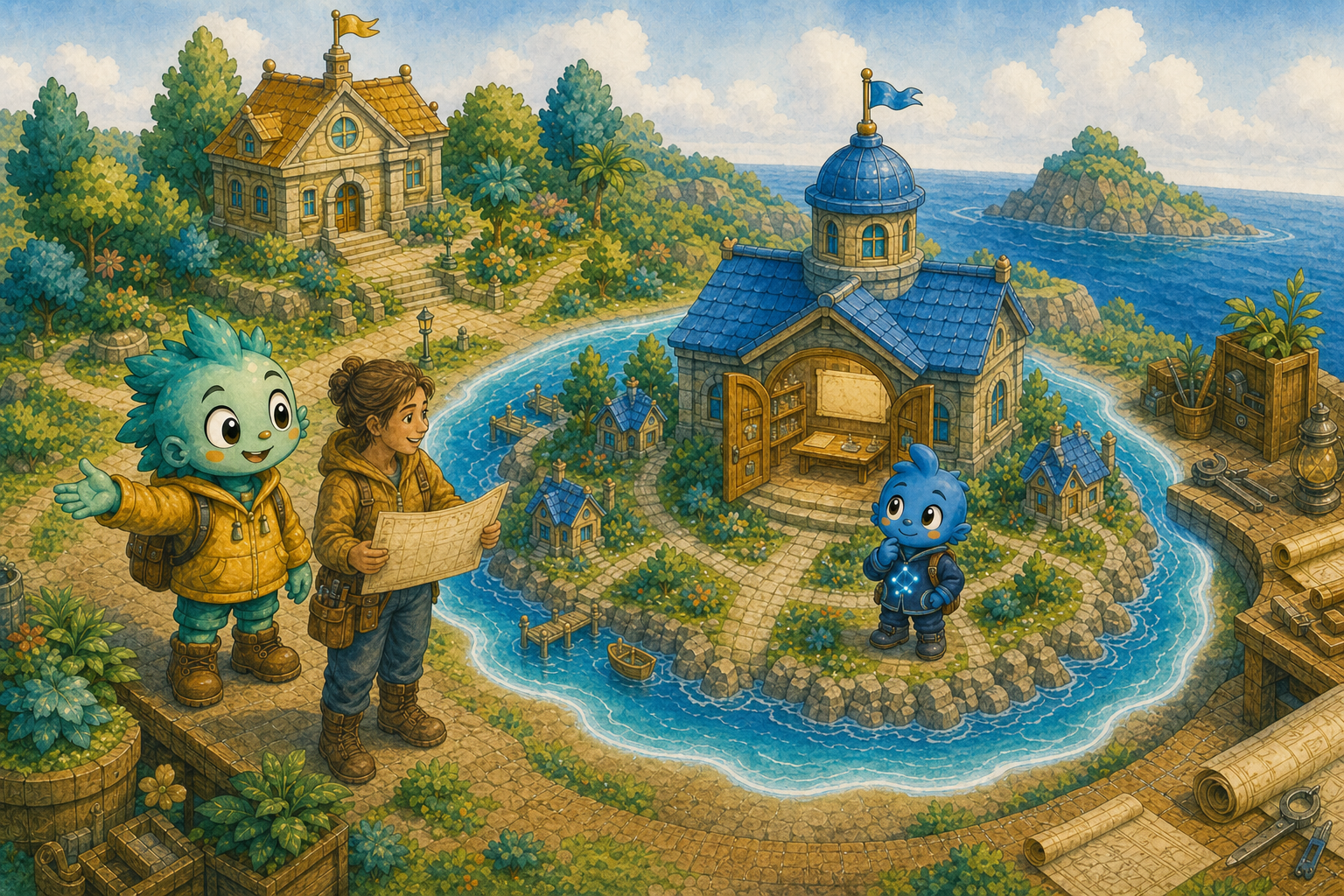
She spread a blueprint across the table. It did not say which favorite tool everyone had to use. It said what had to work reliably in the end.
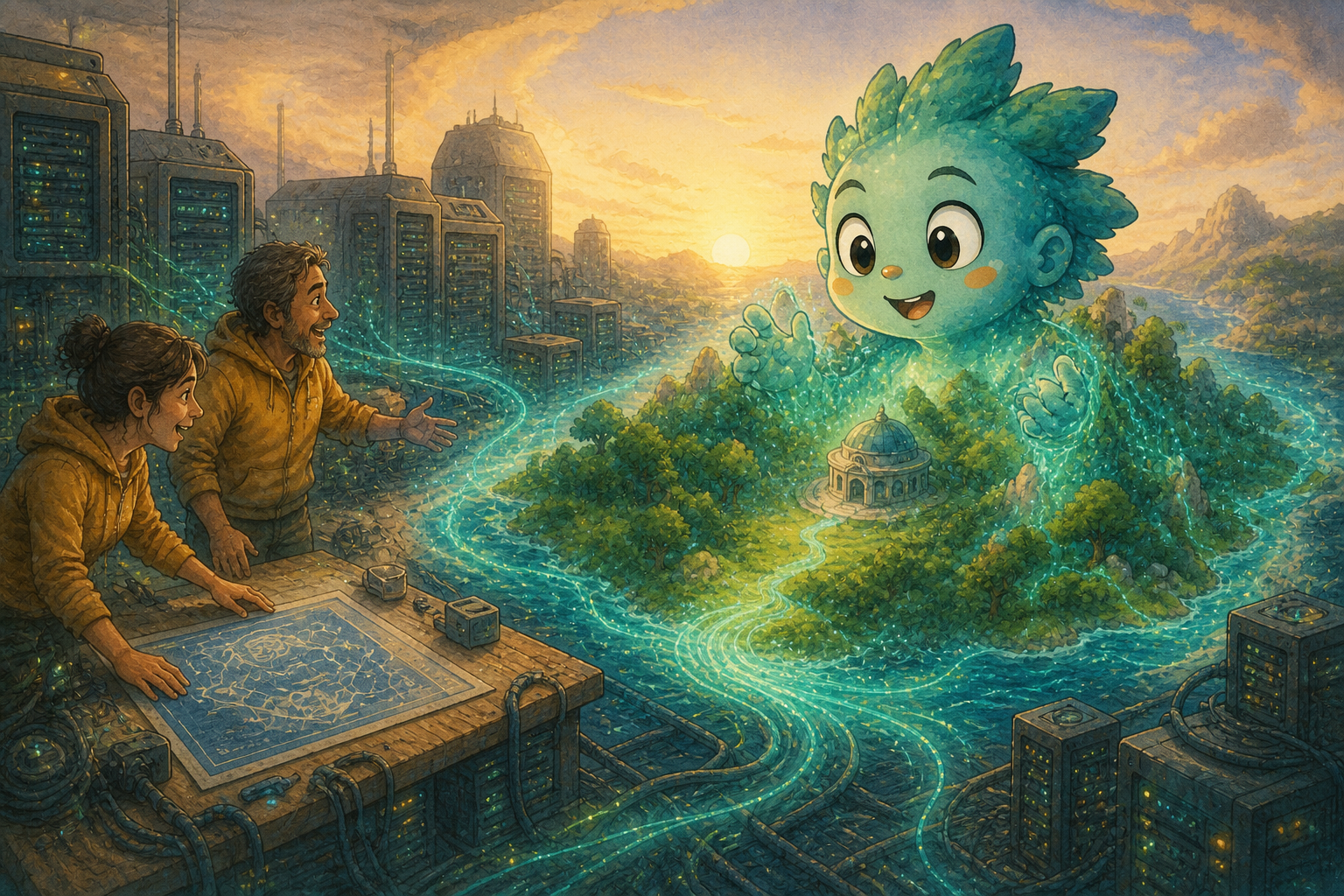
Then the ground began to hum softly.
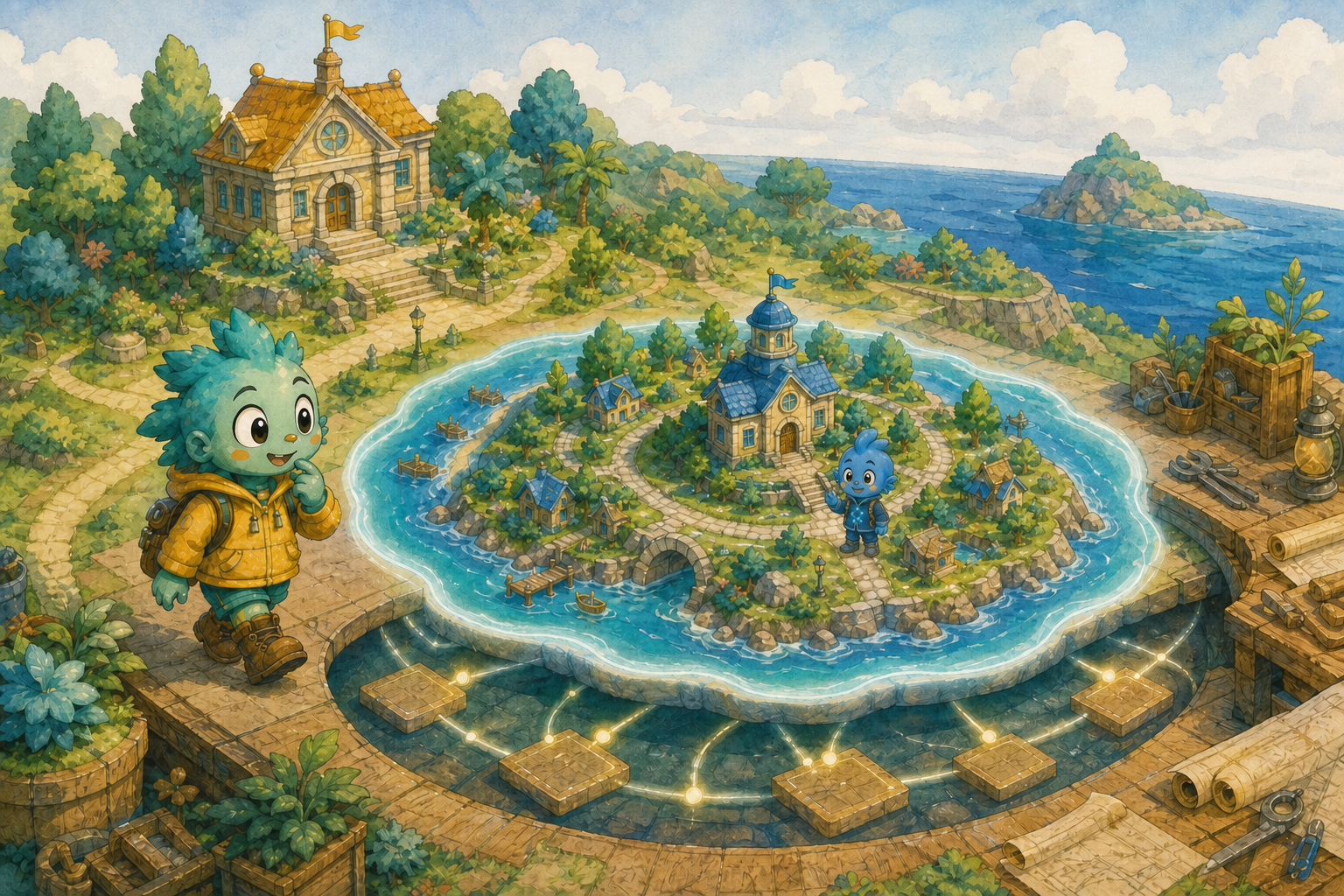
Suddenly, blue and green lines lit up between the machines. They connected, found their places, and formed an island.
A town hall appeared in the middle of the island. Maps, symbols, and friendly little lights shimmered in its windows.
The new island blinked.
“Hello,” he said. “I’m Oki.”
The builders smiled.
Oki looked across the wide land, at all the machines, and down at his own blueprint. He was excited. But he did not pretend to know everything already.
Instead, he asked the question that would lead him into many adventures:
“Why?”
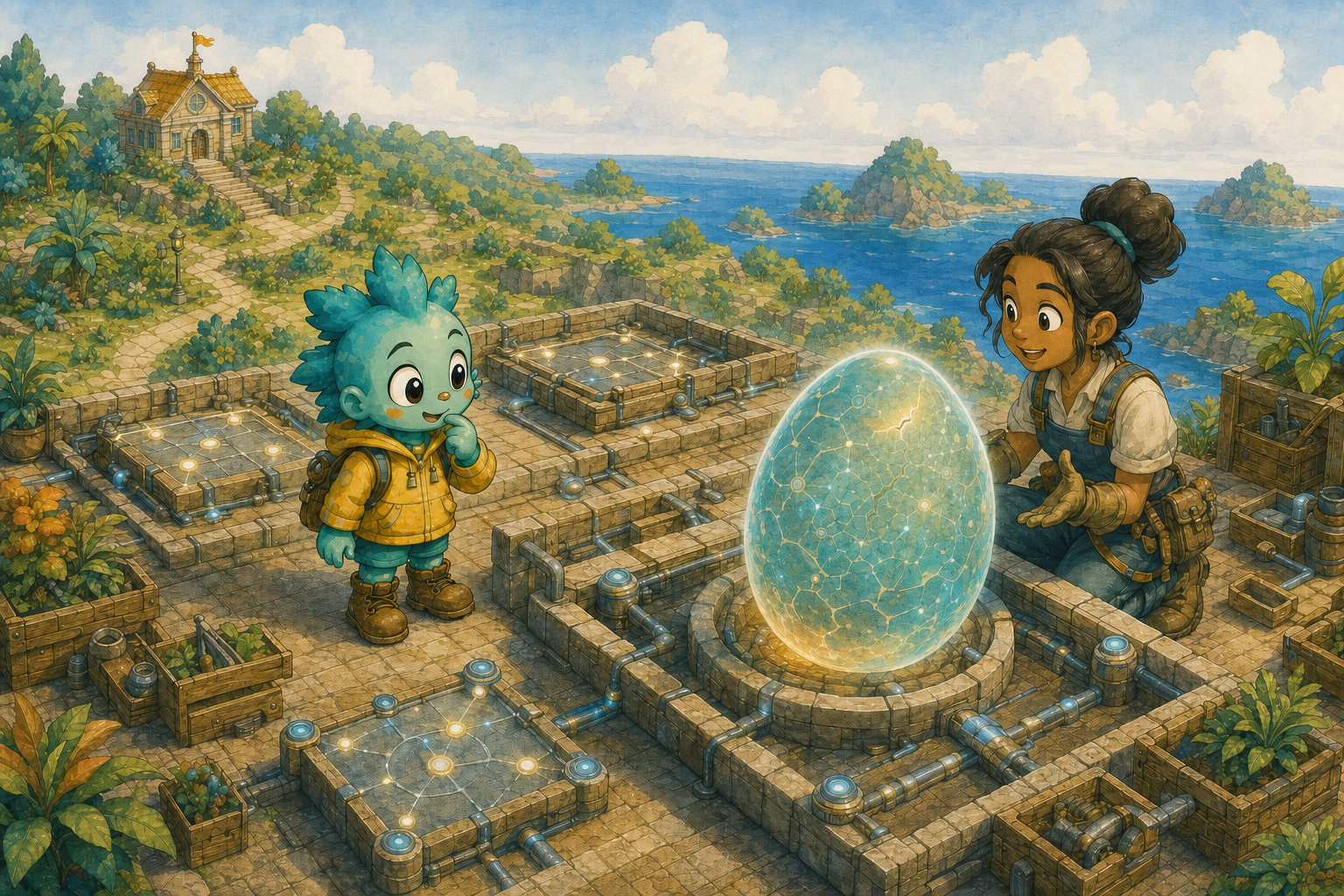
Oki was given a special workshop. Small, protected building spaces could be made there on his land. Each space had walls, connections, and exactly what was needed inside.
“These are not new islands yet,” the builder explained. “But this is where they can grow.”
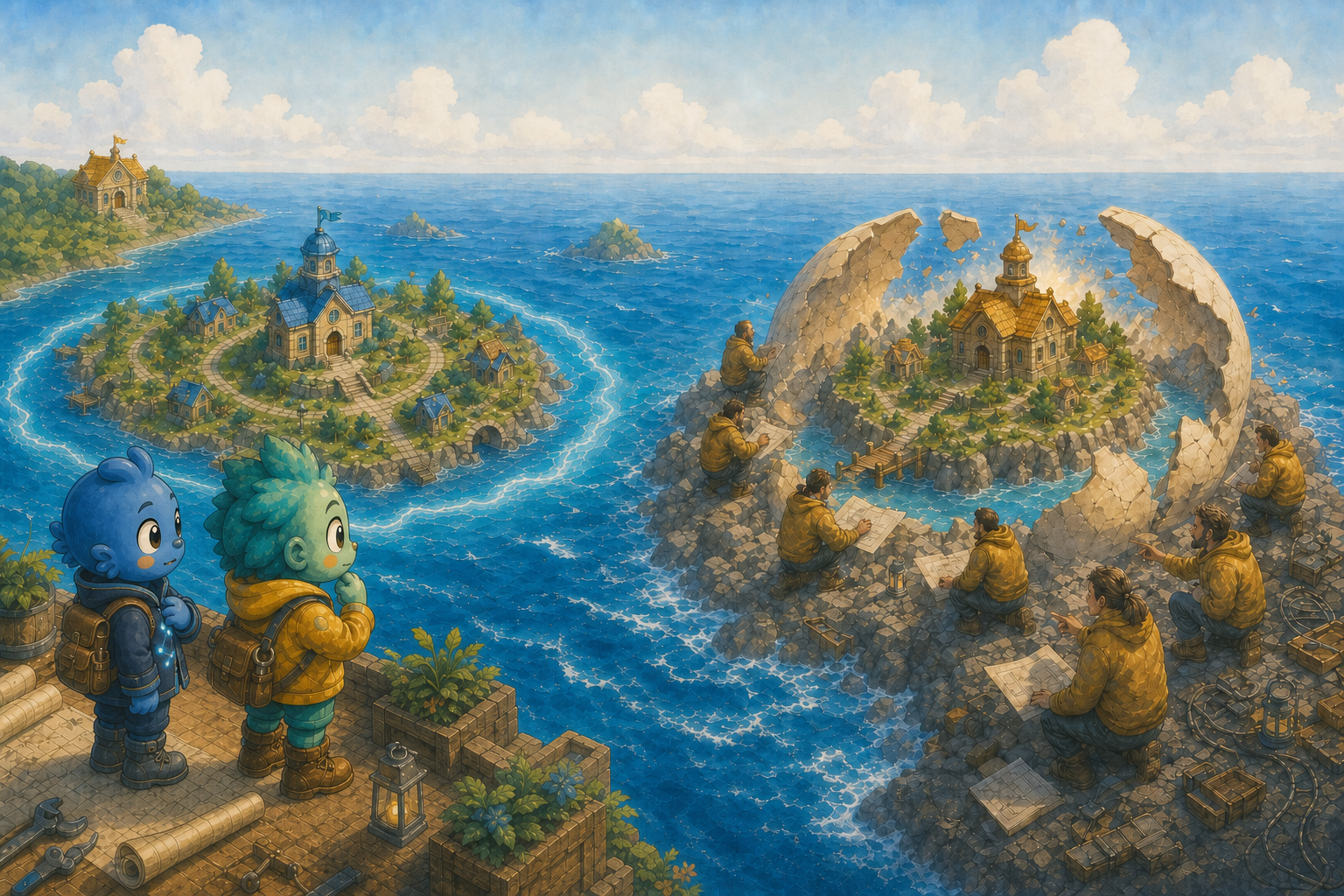
Together, they placed a large, shimmering egg in the workshop. Wishes were written across its shell: room to grow, connections, and a town hall of its own.
Oki held his breath.
Something rumbled inside the egg. First came paths and storage. Then something began to wake up.
A thin crack appeared in the shell.
“Is it finished already?” Oki asked.
“It is only beginning,” said the builder.
CRACK!
A small island emerged from the egg. It stood on Oki’s land, yet it had a boundary of its own, its own paths, and its own town hall.
A small blue figure stood in front of the town hall. A few connected points of light glowed in the figure’s chest. Whenever the island wanted to speak, it spoke through this figure.
Oki walked around the little island once. Then he walked around it again.
“You are an island,” he said slowly. “And you are standing on my island.”
The small blue figure nodded proudly.
Oki sat down in the grass and thought.
“If one island can grow inside another island,” he murmured, “how many islands can fit inside an island?”
No one knew the exact answer. But everyone knew that this question would make their world much bigger.
The young island’s small blue figure stood in front of the town hall. A tiny blue core of connected points shone in Mio’s chest.
“Your technical name is ok-mgmt,” said the builder.
“We pronounce that ok management,” Oki explained. “But your friends will call you Mio.”
“You are the first island to grow on my land from a blueprint we made together,” said Oki. “Mio—my first island.”
Inside the town hall were tables for blueprints, cabinets for rules, and a large map for other islands.
“Should I build all the islands now?” Mio asked eagerly.
“Not yet,” said Oki. “First, you will learn how to take responsibility. Other people build an island. Then they introduce it to you on purpose. Only after that do you help take good care of it.”
Mio thought for a moment.
“Can I do that yet?”
“We’ll learn together,” said Oki.
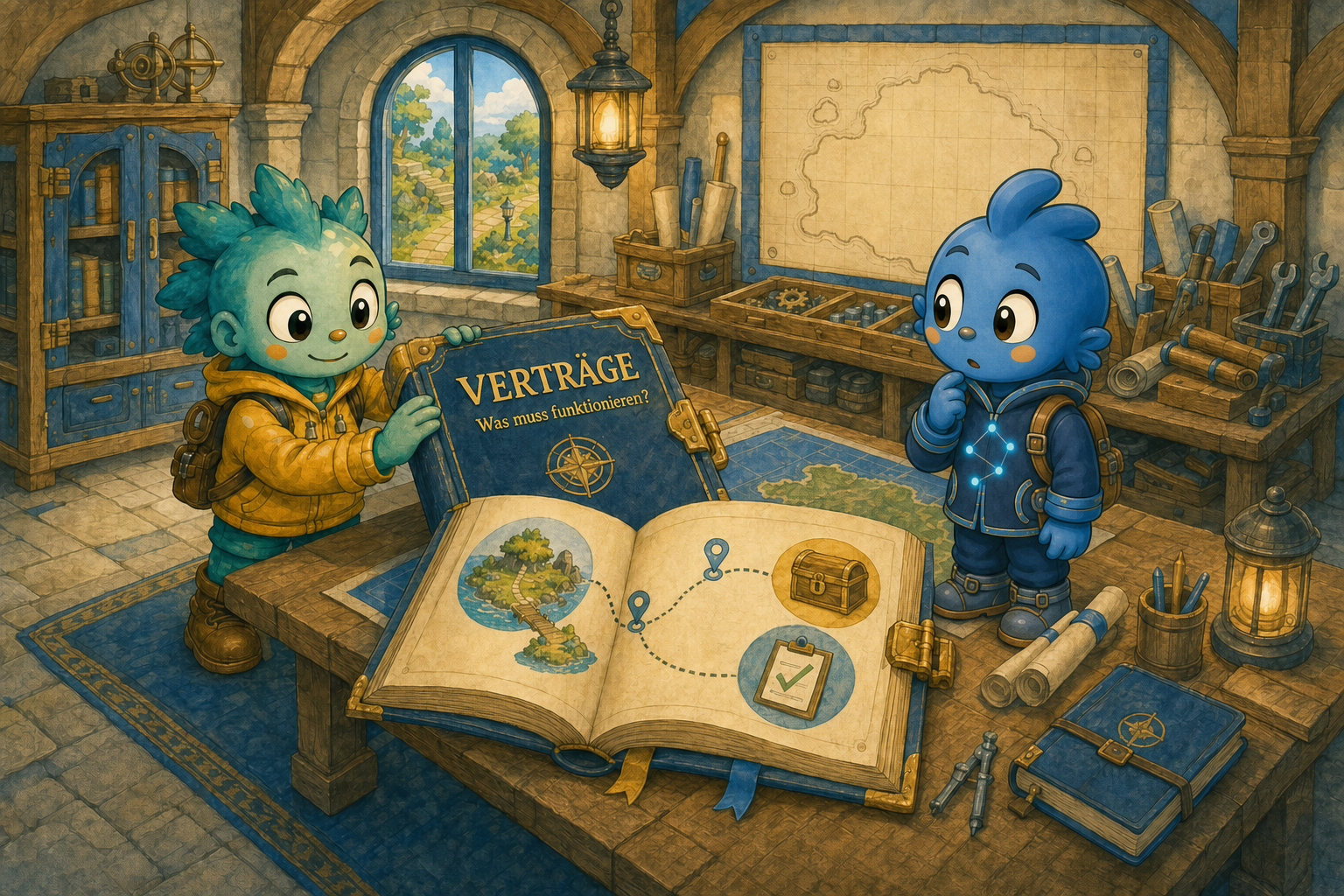
Oki carried a thick book into the new town hall. On its cover were the words:
CONTRACTS
What must work?
“Does it list all our favorite tools?” Mio asked.
Oki shook his head.
“Tools can change. This book holds our promises.”
An island should be reachable. Its paths should work. Important things should be kept safe. And anyone who said an island was ready should be able to prove it.
“Promises instead of favorite building blocks,” Mio read.
“Exactly,” said Oki. “That way, we can discover better tools without reinventing the whole world every time.”
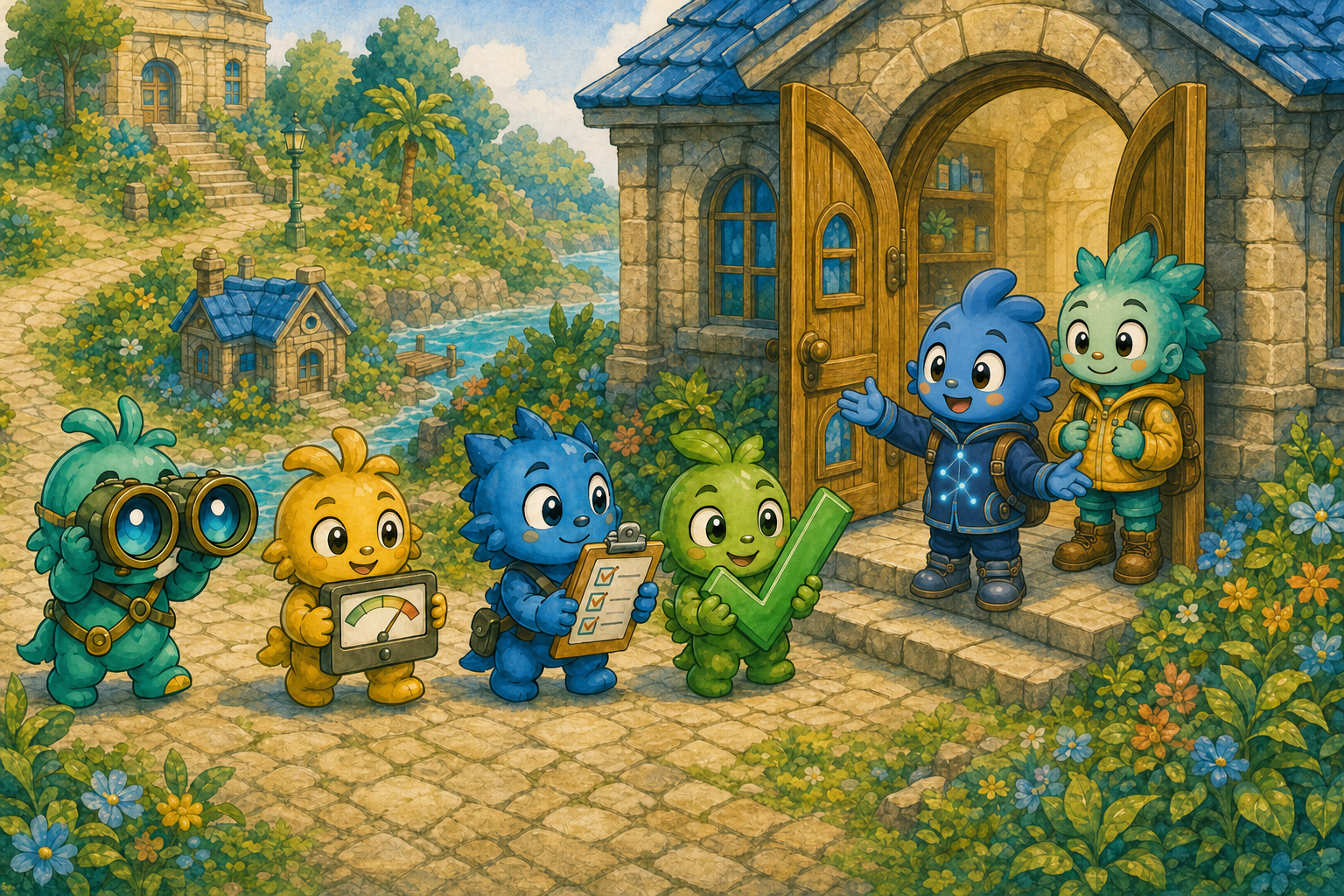
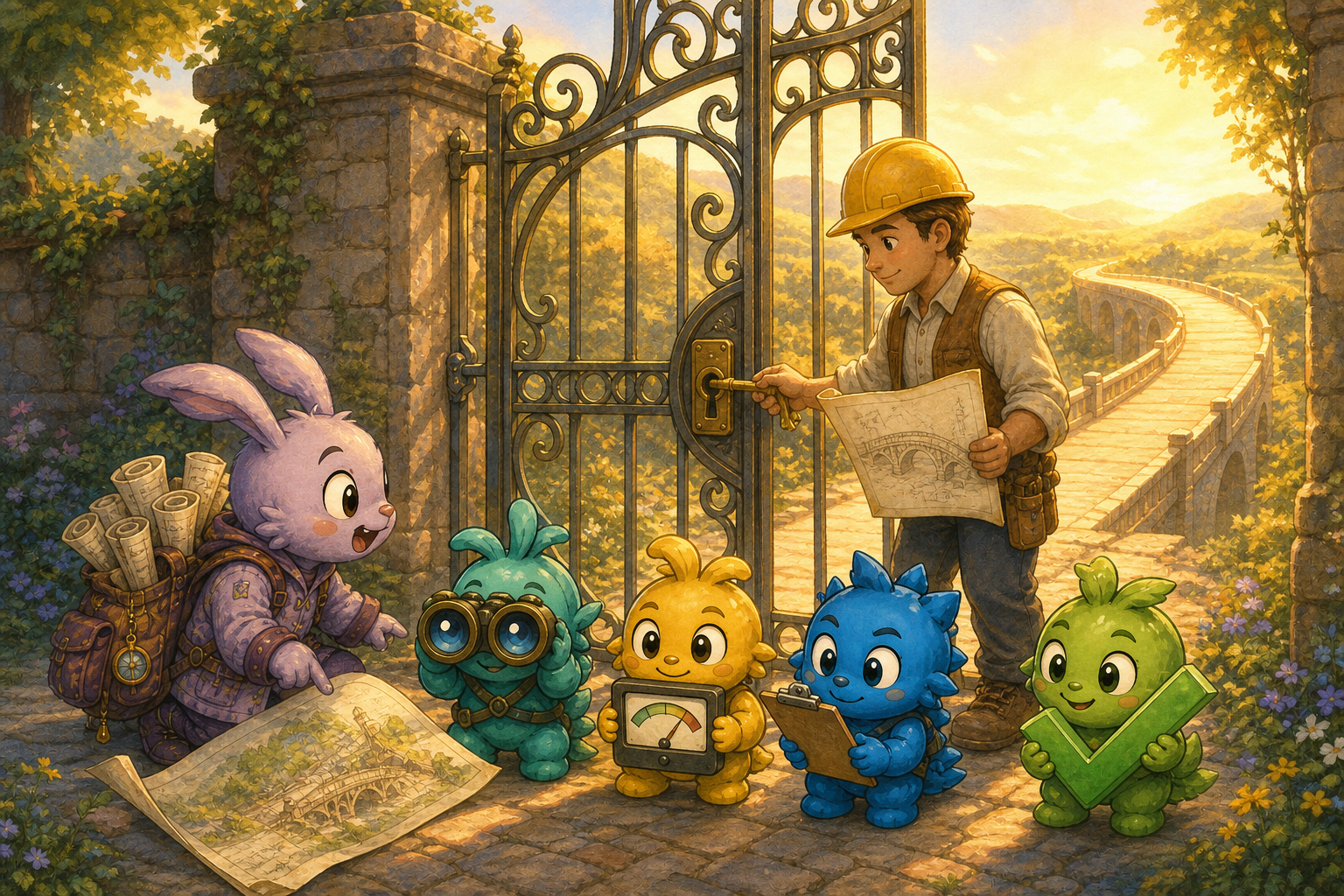
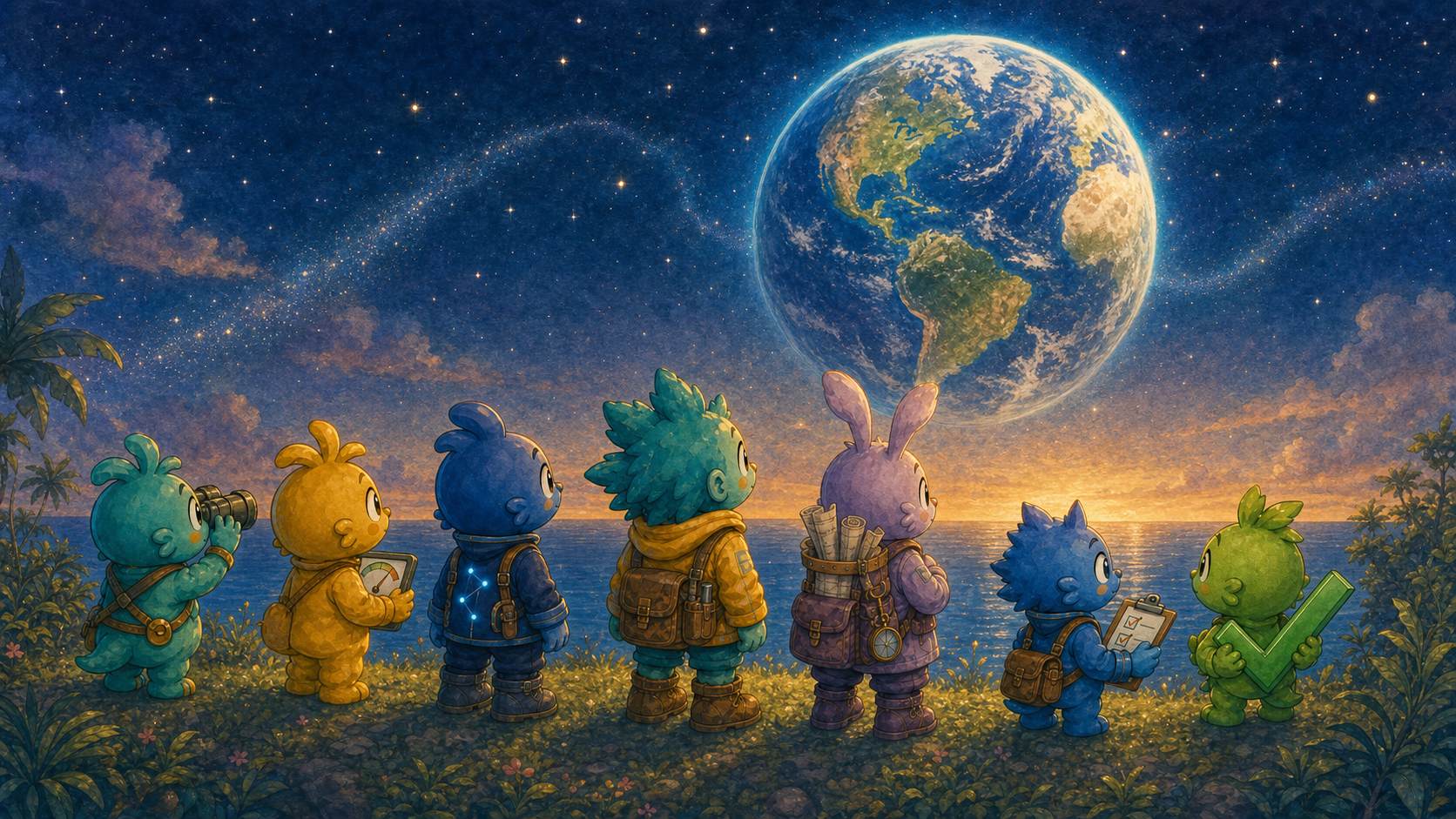
The next morning, four small visitors knocked on the town hall door.
Scout carried binoculars. “Can I see it?”
Meter held up a measuring device. “What does the measurement say?”
Check brought a clipboard. “Does it match the promise?”
Proof rolled in a large green check mark. “Show me the evidence!”
Mio stared at them. “So you decide what we should do?”
All four shook their heads at the same time.
“We check facts,” said Check.
“We show what is true,” Proof added. “But my green check mark is not a key.”
Oki nodded with satisfaction. That was an important difference.
Far beyond Oki’s shore, another building team was at work. They knew the Book of Promises and wanted to build a new island for a particular job.
The team mapped out paths, prepared the ground, and helped a new cluster egg grow.
After a while, it went CRACK!
An island with its own town hall appeared on the horizon.
It was truly there. But it was not yet on Mio’s map.
“Did you build it?” Oki asked.
Mio shook their head.
“No. The building team built it.”
“Good observation,” said Oki. “Existing and being connected are two different things.”
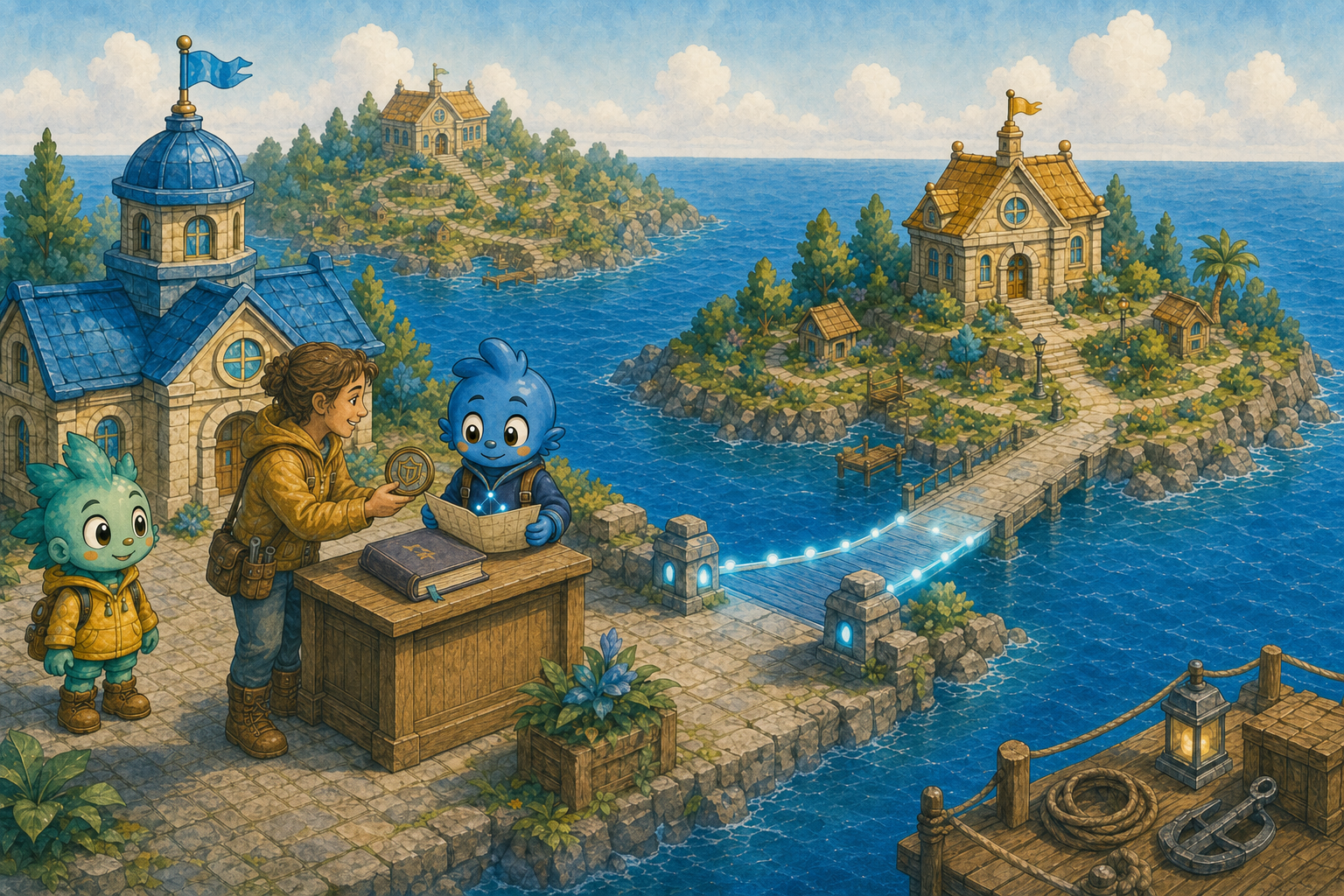
The building team brought the new island to Oki’s harbor.
“We would like to introduce this island to Mio,” said the builder. “We want it to become a deliberate part of the island family we care for.”
Mio did not open a connection secretly. Together, everyone checked who the island was, which promises applied, and what responsibility they were agreeing to take.
Then they entered the island’s name on the large map.
A secure bridge lit up.
A new point appeared in Mio’s glowing core. The new island had already possessed its own light. The point meant only one thing: a deliberate relationship now connected them.
“Welcome,” said Mio. “Now I know you. We can help provide the things we agreed upon—and then check whether the promises are truly being kept.”
The new island smiled. A meeting had become a reliable relationship.
“The island is here,” Mio called out. “That means everything is finished!”
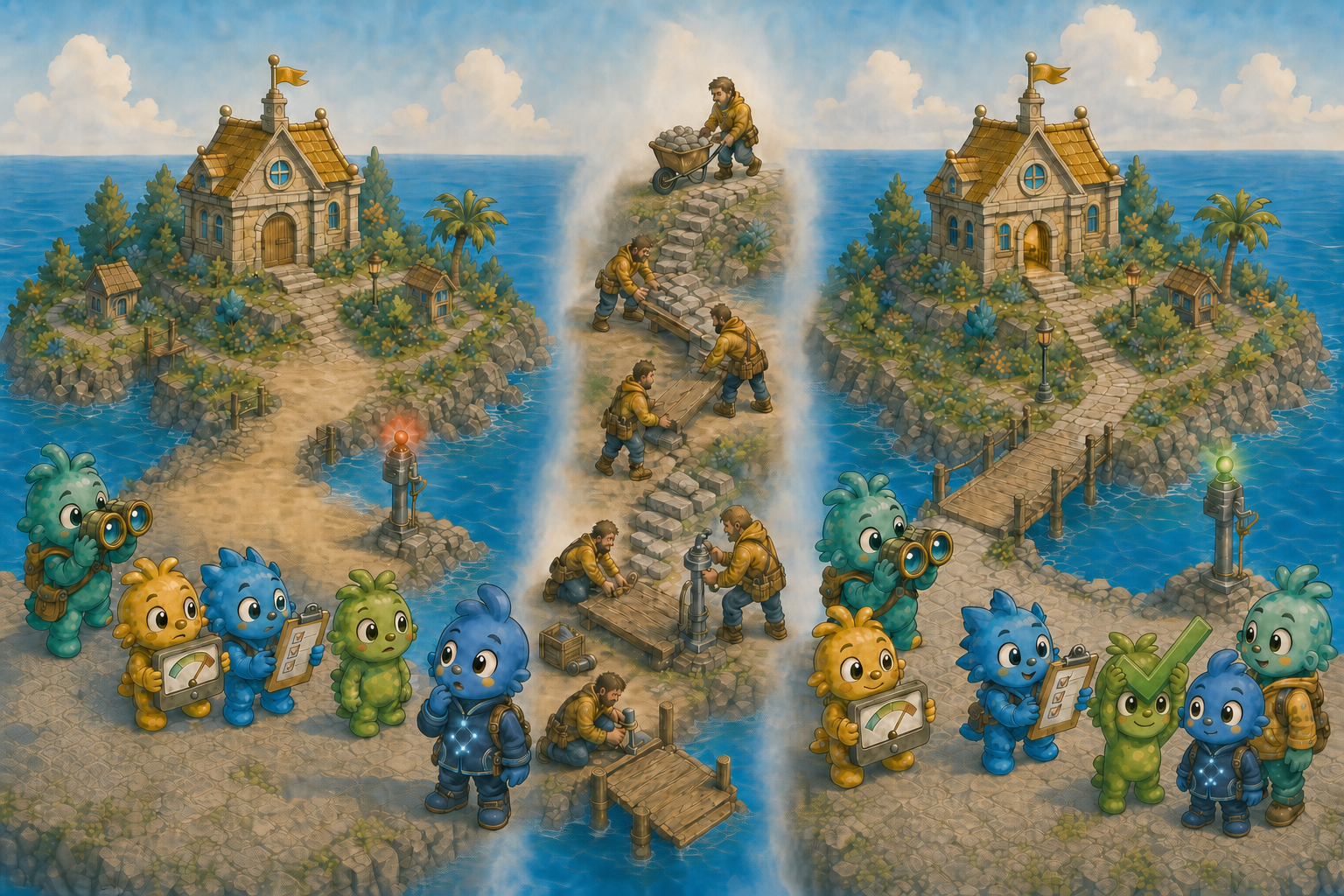
Scout looked through the binoculars. Meter studied the gauges. Check turned through the pages of the book. Proof waited patiently.
One path still ended in the sand. An important door would not open. And one signal arrived only some of the time.
“But there were no errors while it was being built,” Mio said, puzzled.
“A completed step is not the same as a fulfilled promise,” Oki explained.
The building team took care of the missing things. Afterward, Scout, Meter, Check, and Proof checked everything again.
This time, Proof raised the green check mark.
“Now we have more than hope,” he said. “Now we have evidence.”
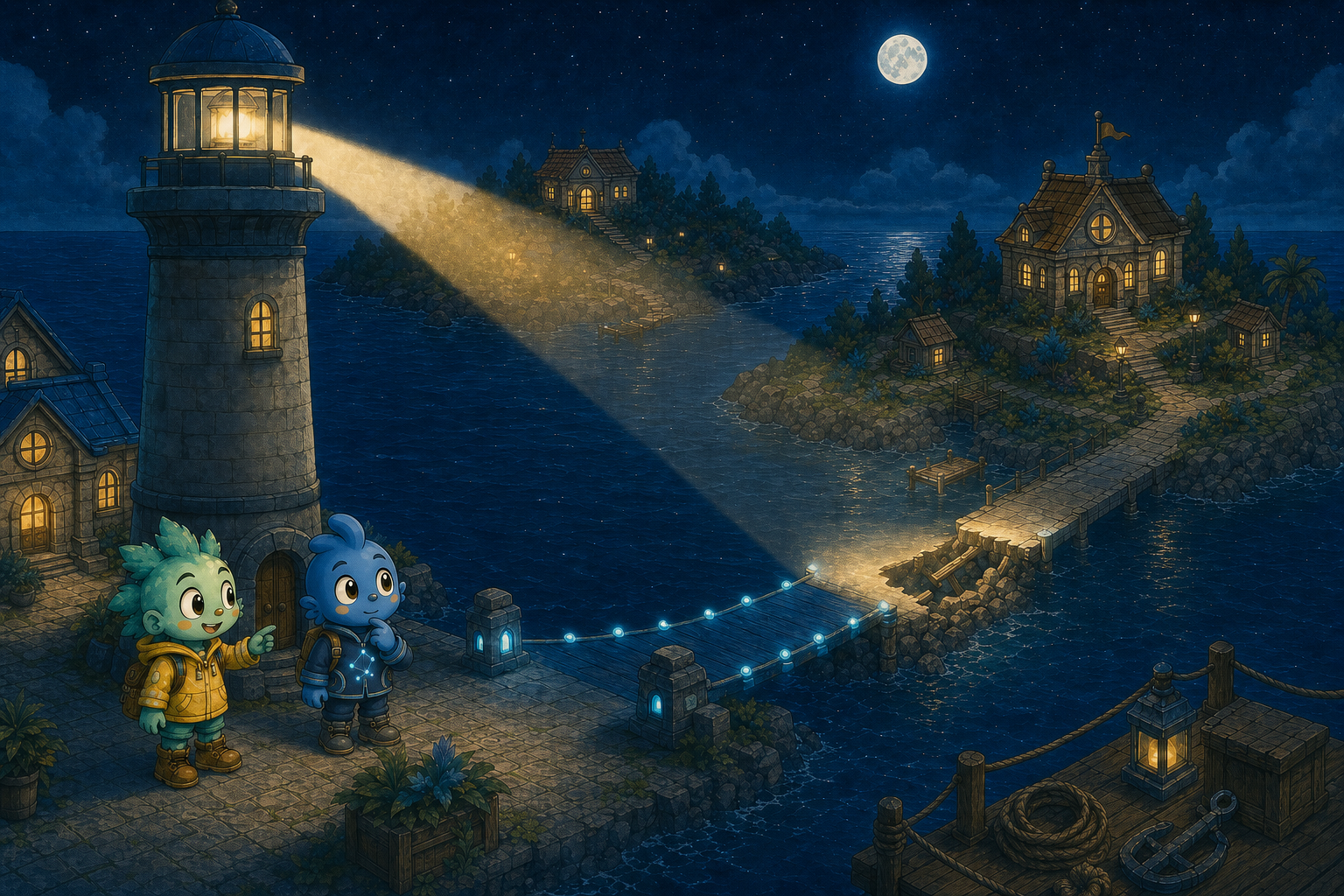
With every new island, the sea became harder to understand. So the friends built a tall lighthouse.
Its beam showed which islands were easy to reach, where a path had become slow, and where something had suddenly gone missing.
“Does the lighthouse prevent every problem?” Mio asked.
“No,” said Oki. “But it helps us see them.”
That very night, the beam found a dark spot on a bridge. The lighthouse did not repair it. It simply showed the friends exactly where to look.
“Seeing is not the same as acting,” said Mio.
“But without seeing, we act in the dark,” Oki replied.
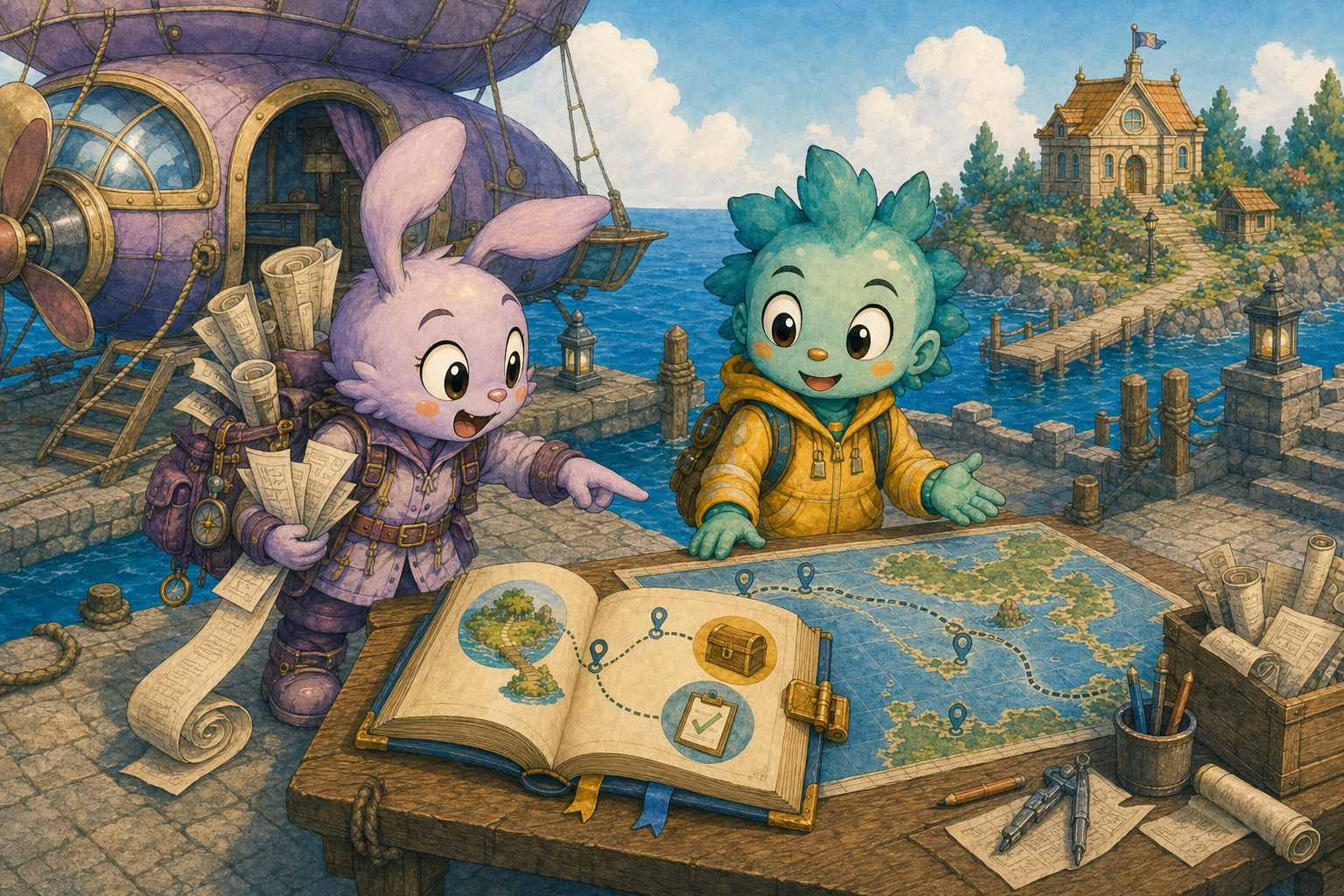
One day, a small airship landed in the harbor. Out jumped Aia, carrying a purple backpack that looked suspiciously full.
“AIA stands for AI Agent,” she explained. “But you can call me Aia.”
She could read quickly, compare many clues, and search the island map for anything unusual.
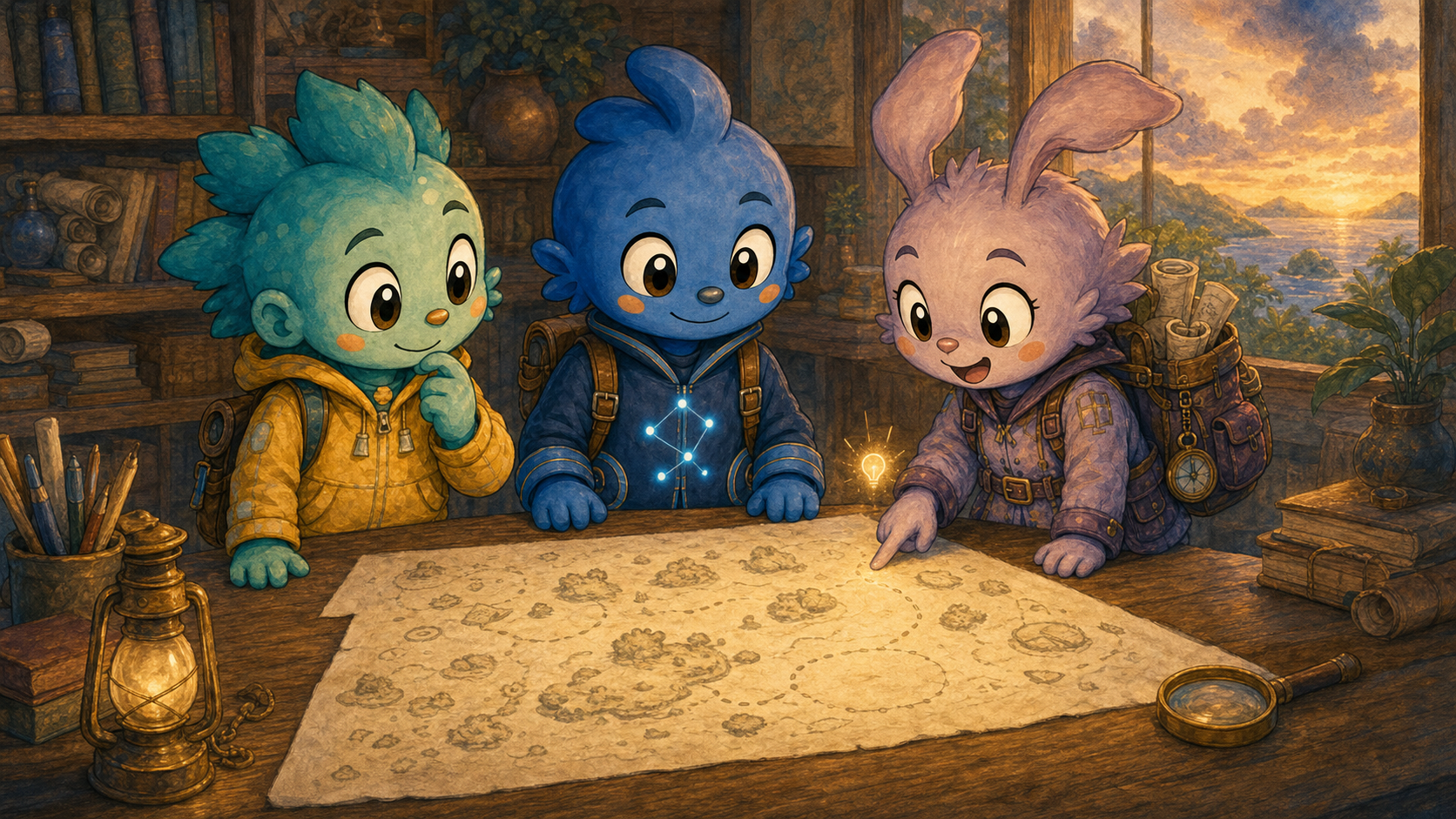
Before long, she noticed that one path did not match the Book of Promises.
“I have an idea,” said Aia. She pulled three plans, two lists, and a surprisingly large roll of paper from her backpack.
“Very good,” said Oki. “Then we’ll check your idea together.”
Aia’s plan, the book, and the sensors’ findings lay in front of a great gate. Beyond the gate, a suggestion could become a real change.
Aia searched through her backpack.
“Where is the key?”
The builder held it up.
“I have it.”
“Because you don’t trust me?” Aia asked.
“I do trust you,” said the builder. “That is exactly why everyone has a clear role. You help us think. The sensors check facts. And people take responsibility for the decision.”
Together, they read the plan, asked questions, and improved one part. Then the builder turned the key.
The gate opened.
Little by little, Oki met many different islands.
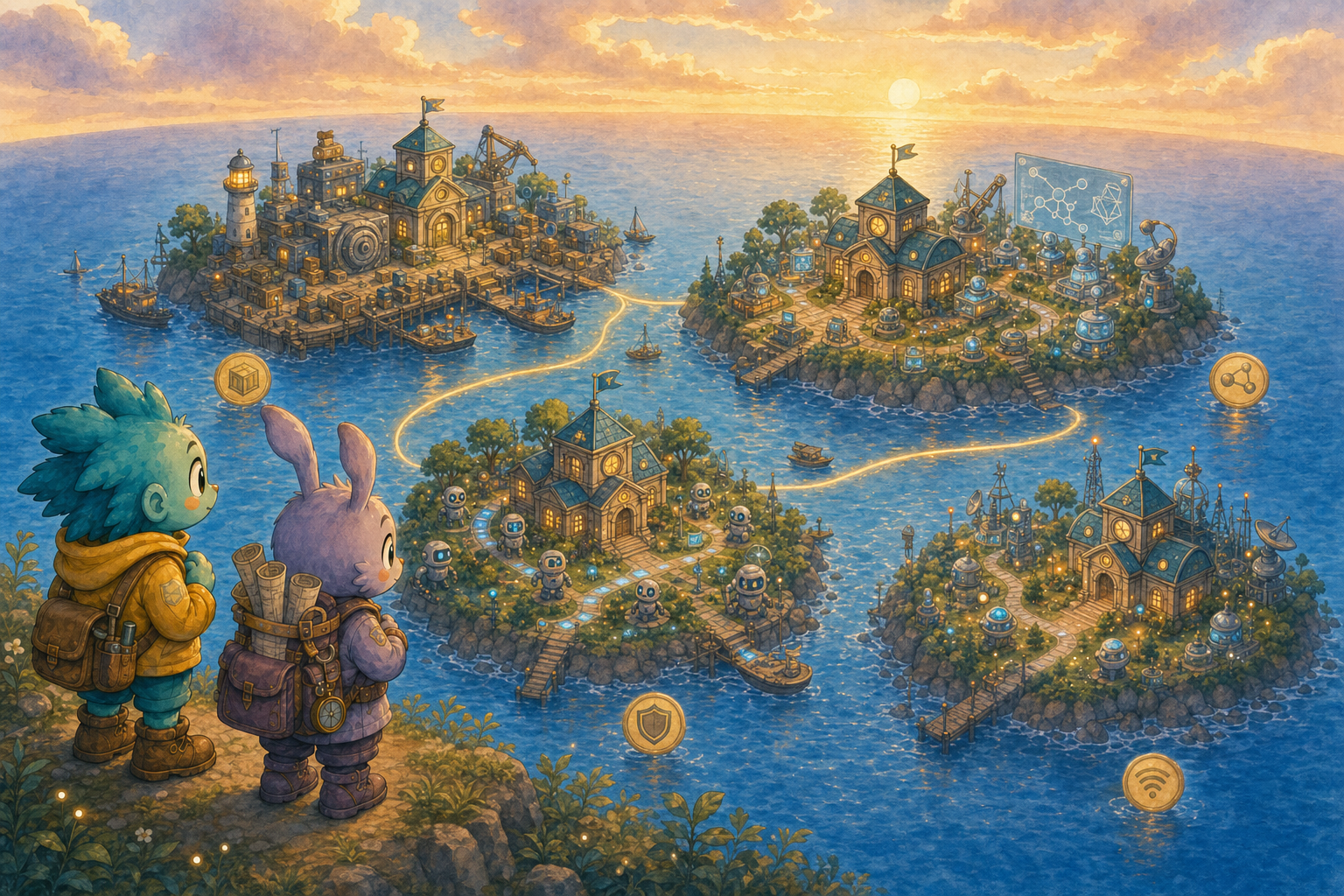
There was the supply harbor ok-shared, with its vault, warehouse, storage, and lighthouse. On ok-ai, people worked on helpful machines. Robots traveled along safe paths on ok-robotics. And from ok-iot, small devices sent messages from faraway places.
Each island had a different job. Each had its own town hall. And all of them could understand the same important promises.
“Do they all have to look alike?” Aia asked.
“No,” said Oki. “Everyone in a family can be different. The family stays together because they can rely on one another.”
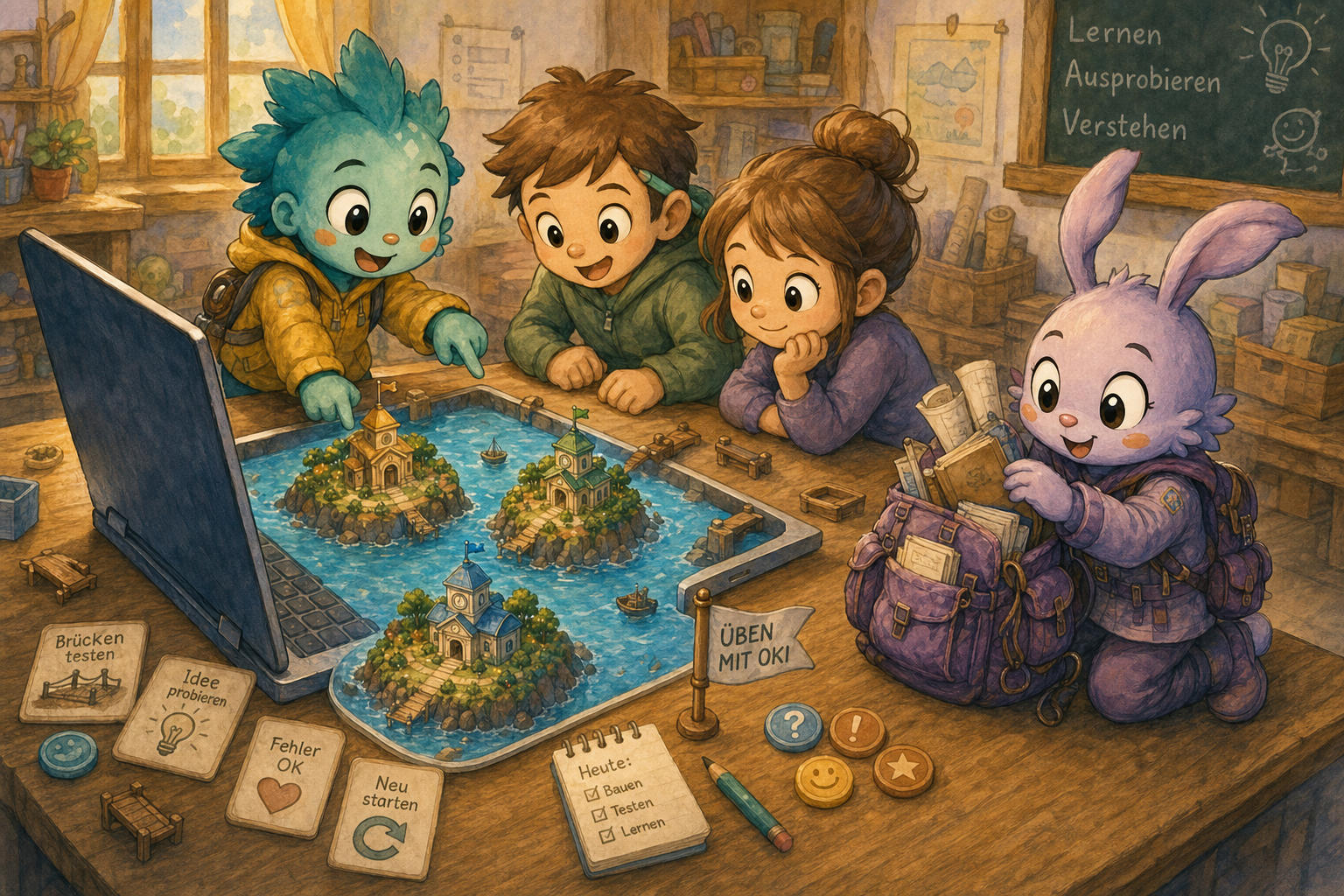
Many people wanted to explore the island world. But not everyone had a wide land filled with large machines.
So Oki and his friends built a small practice world. It fit on a laptop and could even travel inside a backpack.
They called it ok-local.
There, curious explorers could let islands emerge, discover town halls, try out promises, and make mistakes without putting a real harbor city in danger.
“Is it an ordinary production island?” Aia asked.
“No,” said Oki. “It is a place for learning and experimenting.”
Aia stuffed one more notebook into her backpack. Now it was definitely too full.
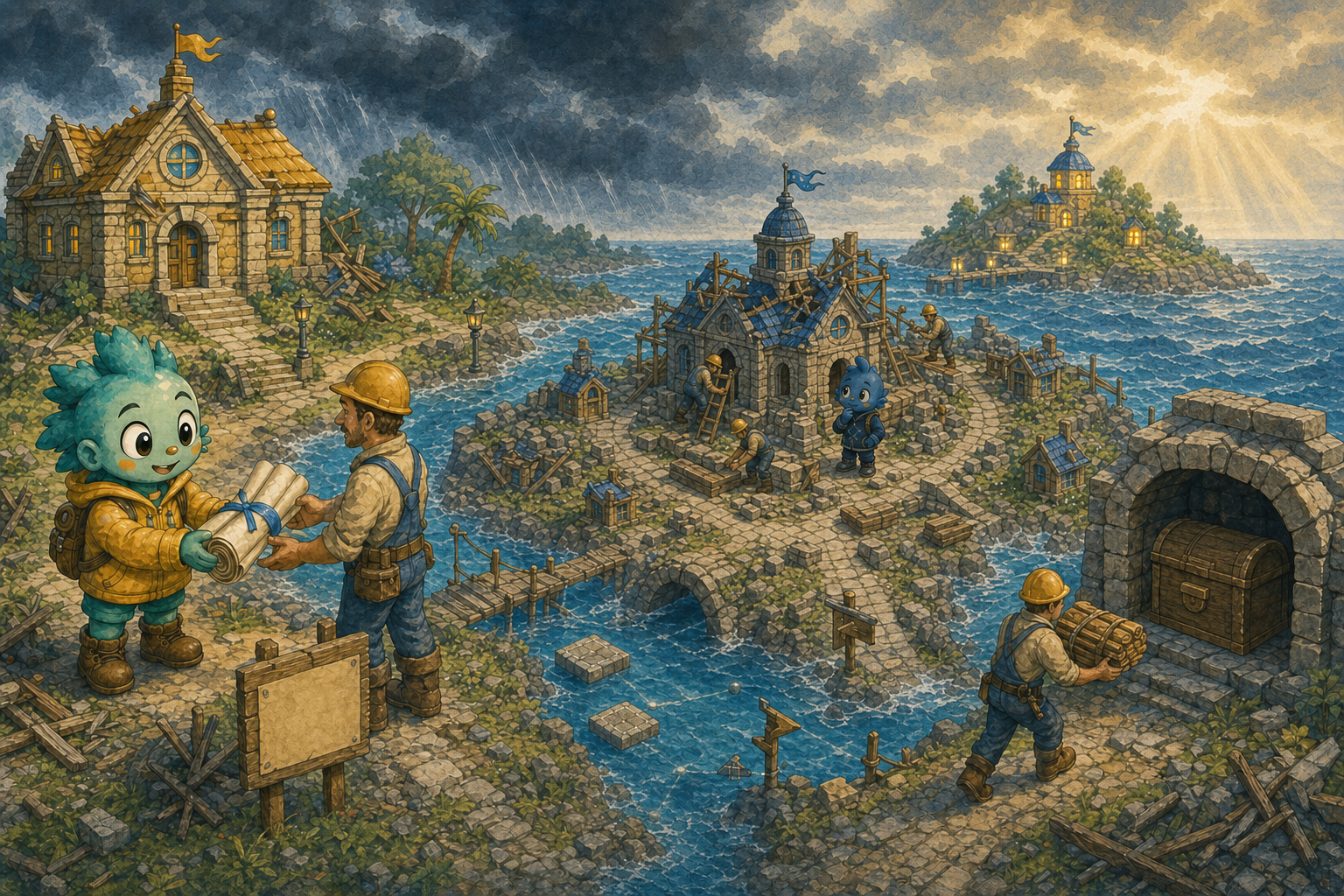
Then the storm came.
Wind pulled at the bridges. Waves crashed against Mio’s town hall, and the large map went dark. Mio’s blue core went dark as well. But the other islands kept shining.
Oki remained the steady anchor outside the young island.
The people brought out the blueprints they had kept safe and rebuilt the town hall and its essential paths. But not everything was written in those plans. Some relationships, access, and memories had to be brought back from their own safe places.
When the light returned, everyone breathed a sigh of relief.
But Mio looked around. “Has every memory returned exactly as it was before?”
Oki answered honestly. “A blueprint can help us rebuild you. But we must also save memories deliberately and restore them deliberately.”
From then on, they never confused rebuilding with getting every memory back.
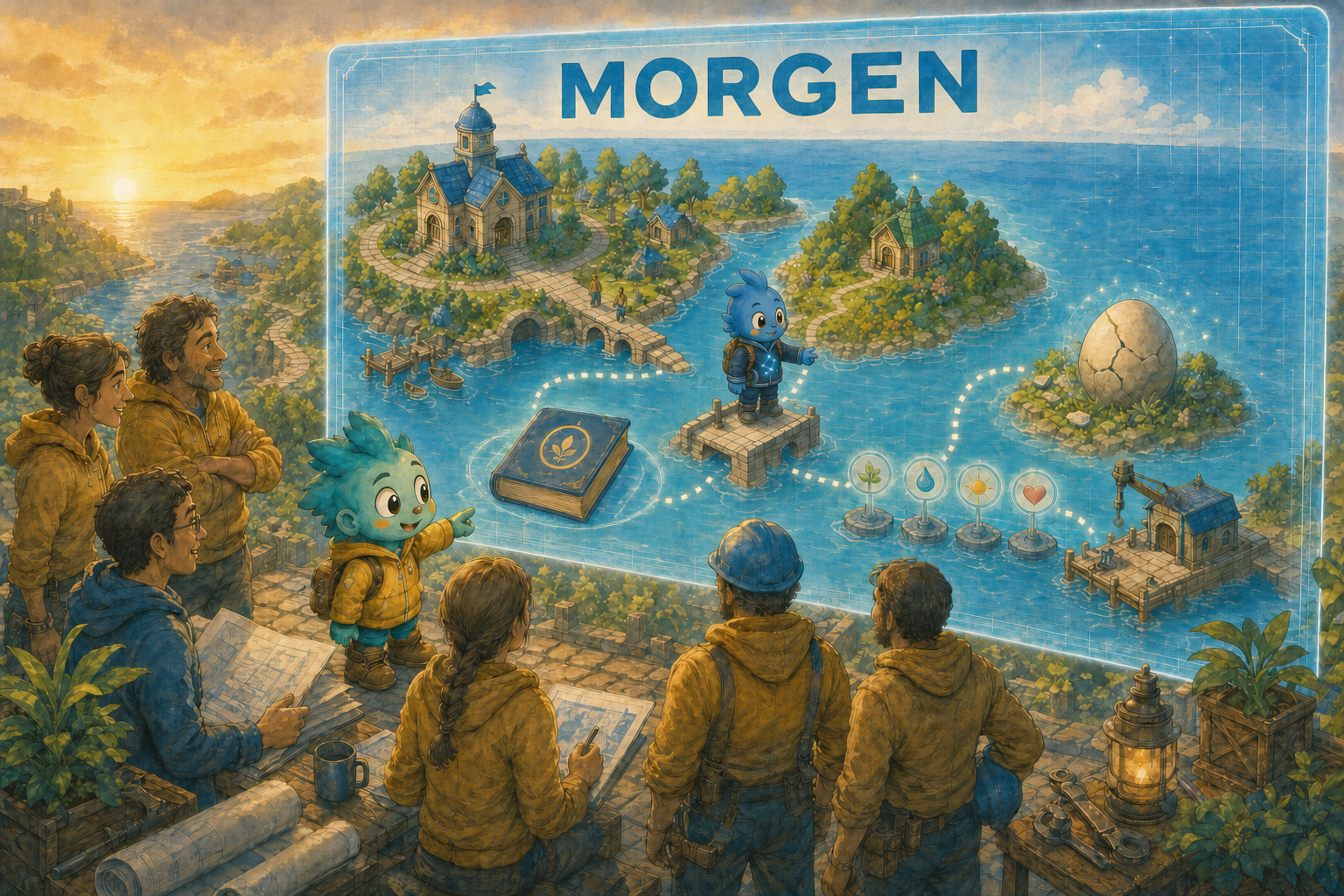
One day, Oki showed Mio a special blueprint. Across the top, in large letters, was the word TOMORROW.
The plan showed how Mio might one day guide new islands from the very beginning—from the first egg to an island whose promises had been proven.
Mio remembered the first question they had asked: “Can I do that yet?”
This time, Mio studied the plan for a long while and said:
“That is my responsibility.”
“And I won’t do it alone,” Mio added. “I help turn a good plan into a reliable island.”
“For now, this is our goal,” said Oki. “But every good goal begins with a clear promise.”
One morning, a new cluster egg appeared on the beach.
A young cluster stood beside it, looking uncertain.
“Can I do this yet?” he asked.
Mio remembered those first days. Mio stood beside him, not in front of him.
“You don’t have to know everything on your own,” said Mio. “We have blueprints, promises, sensors, and people who take responsibility.”
Something began to tap softly inside the egg.
Mio smiled.
“When you are ready, you will help the next island begin its journey.”
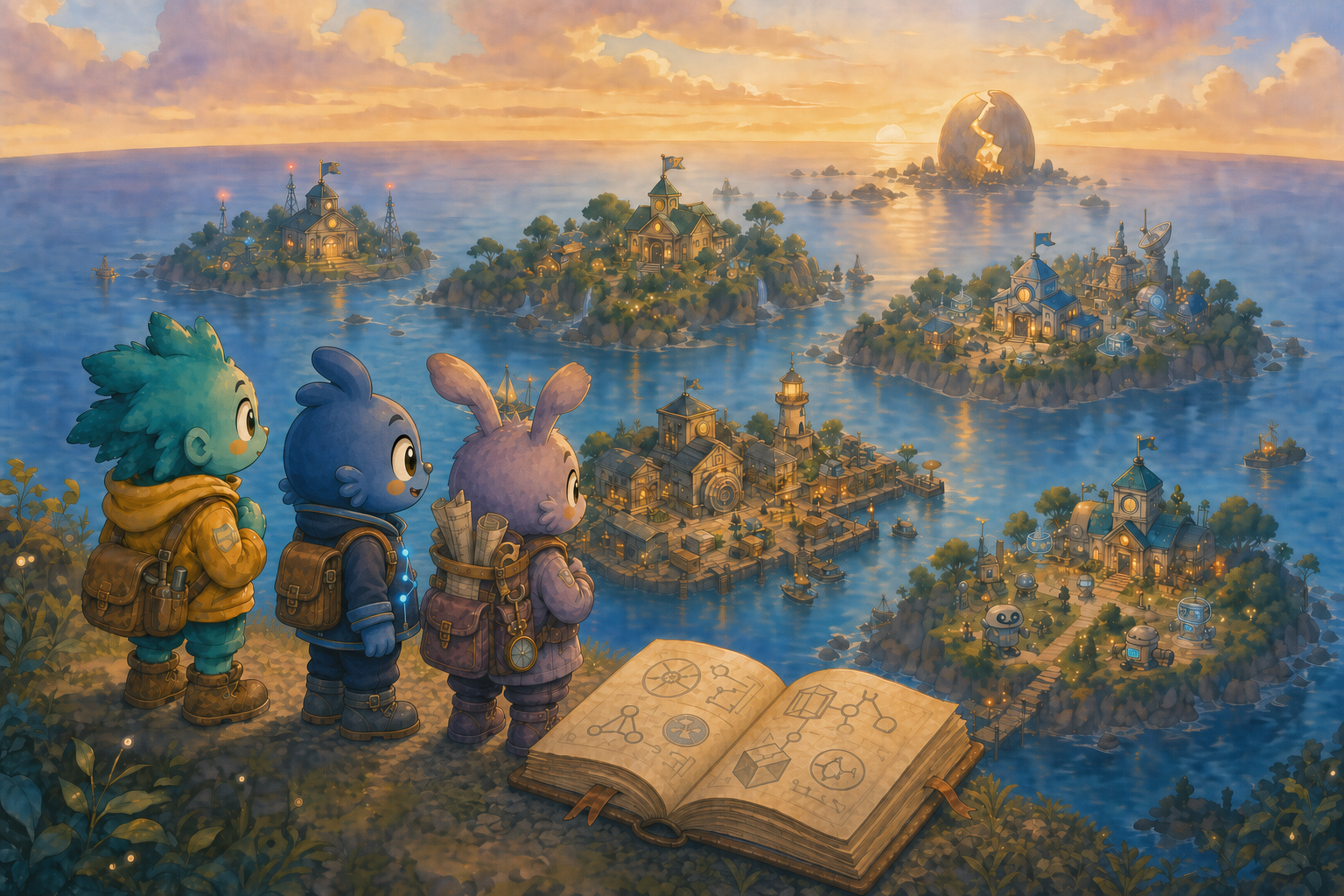
That evening, everyone stood on the highest hill. Below them, many islands glowed: large and small, near and far, quiet and busy.
The young cluster pointed first to Oki, then to Mio, and finally to the whole island family.
“Which one of these islands is OpenKubes?”
Oki smiled.
“Not a single one.”
He opened the Book of Promises.
“OpenKubes is a good way to build reliable islands again and again.”
The friends looked out across the sea.
Build. Connect. Verify. Learn. Grow.
Somewhere in the distance, they heard a tiny sound.
crack ...
Build. Connect. Verify. Learn. Grow.
Not a single island. A shared method for many different platforms.
But when is it not merely there, but truly reliable?
Text and concept: OpenKubes Community. Illustrations: CC BY 4.0; OpenKubes/Oki names, logos, and trademarks excluded.